Much like the origins of the spoken word, those of the written are often forgotten.
And the marks that make up those words? Mostly never thought about. This can also be said of the question mark, the exclamation point, quote marks and the beautiful, beautiful ligature. Turns out their history is pretty interesting.
In September 08 I wrote an article on a small collection of typographic marks that had interesting histories, weren’t often seen in use or were often abused in their applications. It was a lot of fun and I wanted to give it another go.
But rather than have a look at a few of the lesser-known marks we use like I did with the previous article, I thought I’d go for the exact opposite — have a look at a couple of marks we all know about and use.
The Question Mark
Latin for question, quaestiō may be where the origin of the Question Mark can be found.
Whenever our Latin writing friends wanted to indicate a question or query, they would add quaestiō to the end of the sentence.
Lacking a sense of elegance, and not to mention taking up quite a bit of space, quaestiō was abbreviated to QO. This worked wonders for the scribes as their jobs became a little easier and they could produce texts quicker and have more space to work with.
But for some, QO seemed like a word with missing letters. To counter this, the O would be placed beneath the Q, rather than next to it — a clever little move that turned QO from an abbreviated word, to a glyph unto its self.
Being that this was now a sort of symbol that was always drawn by hand, the evolution of it to the question mark we know today is fairly evident (and pretty damn cool).

This evolution feels like a worthy explanation — but is it fact? Maybe not. The question mark has–excuse me for this–many questions around it and this is just the nicest solution for me.
The other thoughts on the question mark’s origin range from an evolution of the semicolon (which is used in Greek to indicate a question mark, but looks to have come into popular use well after the question mark did), the cats tail as it curls when it’s curious and the notion of it being a lightning strike mark that slowly evolved … even though it was only seen for a brief period of time then fell out of use.

A note on the Exclamation Point
Following on the heels of the Question Mark, the Exclamation point helps to lend some legitimacy to the history outlined above.
It is loosely accepted that the exclamation point come from the abbreviation of the Latin io, meaning joy.
From this, and most likely with the same conservation of space in mind, the evolution is the same as that with quaestiō — the i was written above the o, and it eventually evolved into the note of admiration that it is today.
Quote Marks & Blockquotes
Early in it’s life, the quotation mark would appear a little haphazardly and overly used, often being set in a different typeface to that of the main copy.
Traditionally, when a blockquote was part of a text, the entire paragraph would be italicized to indicate speech. But when our curly little marks came into popular use, the italicized lines were done away with, and instead, we were given long quotes with quotation marks at the start of every line.
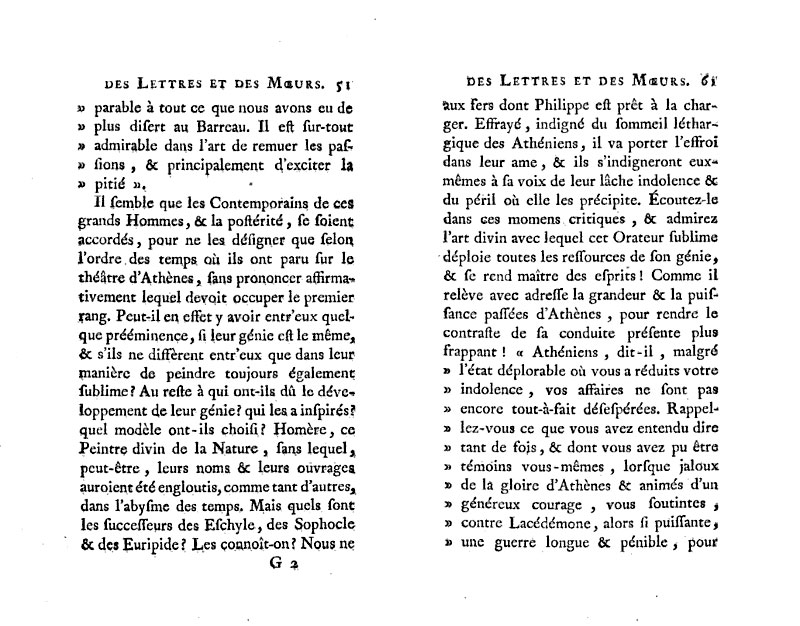
depuis les Grecs et les Romains — 1787
Clearly cumbersome and visually redundant, it was the printers of the sixteenth century who decided to do away with their excessive use.
But something interesting occurred — rather than set the text and marks flush left with the margin of the rest of the text, the typesetters decided to leave the indentation in place for long quotes.
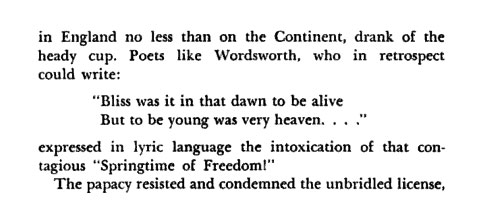
Unfortunately, an earlier example couldn’t be found
This indent became standard practice and is still seen today in large blockquotes set in print and online.
I can’t help but wonder if this is where the idea of hanging bullets, numbers and quote marks in the margins began? Is it possible that typesetters began to shuffle the text so it was aligned with the rest of the body, but left the quote marks to hang to the side? With bullets following?
The ligature
The little secret that only a select few knew of — something hidden under the surface or so many bodies of text, but only found by those seeking out the detail. A little bit of cherished elegance is the ligature.
There are a few combinations of letters that become too unsightly and unbalanced when brought together. The craft that has gone into their making seems to all but disappear completely.
To correct this, we have ligatures, in which two letters are joined together to go from heinous to beautiful.

set in Adobe Caslon can be found in the full version of this image.
It is often suggested that this begun when Gutenberg had his letters cut for his Bible in an effort to save time (one piece of metal being easier to set than two) and space (again, one being better than two).
And to an extent, this is true. But his type was designed to mimic that of the scribes as faithfully as possible. Combining two letters to be one (or three, or four) was common with the handwriting among scribes to help the hand glide across the paper with speed, and had been for as long as man has made marks which had linguistic meaning.
It was also an aesthetic necessity for Gutenberg to use ligatures, lest he have gaps in his words where one could visually tighten the text. The (wonderful) texture of his two columns may have become tattered and mechanical.
So perhaps the ligature might have been first cast by Gutenberg but I’m not sure he should be considered any more responsible for their existence than he is for any other letter or mark he printed, he merely solidified it in typographic history.

to the metal of his letters
Just for funsies
I ended the previous Typographic Marks Unknown article mentioning that one can get by just fine without knowing how such little glyphs came to be or their history.
I could say the same here.
It might not be information that will make or break a potential graphic designer, but knowing such little nuances of our history and our profession, helps us become a little better at it. Understanding how language and typography evolves helps us understand where it may be going and how to communicate to those around us.
Master Your Craft.
Weekly.
Become the designer you want to be.
Join a group of talented, creative, and hungry designers,
all gaining the insight that is helping them make
the best work of their lives.