“Clarity!” Demanded the Modernists

The design shouldn’t uselessly babble and scream until it’s foaming at the mouth.

It should speak clearly and be easily understood. It should have a charming level of clarity and character as all parts are given a reason for taking up space.

It has to be quickly and easily understood, as elements accent the message and design, never drowning them.

This is where the soul of the early 20th century modernist lives.

Fifty years before the Swiss movement really got some bounce, The New Typography got the ball rolling.

It started as the 20th century was moving into its early years, with the Bauhaus and the Futurist art movements fueling the fire.

Before the design was clean, it was messy. Before it was quiet, it was loud. Very loud. To the modernist, this wasn’t appropriate. It wasn’t easy to digest information and too much intervention upon the message was being done by the designer.

Let’s have a look at where it all began for the modernists — with The New Typography.

Snuffing the Beauty of the Message

It could be said that all design is beautiful. All design has a meaning to it—something it is trying to say or do.

The role of the designer is to nurture this beauty. To let its natural form come from an unobstructed function. In other words, the easier it is for a strong message to speak clearly, the more beautiful it will be. A butterfly held too tightly and all those clichés.

But at the end of the 19th century this wasn’t the case.
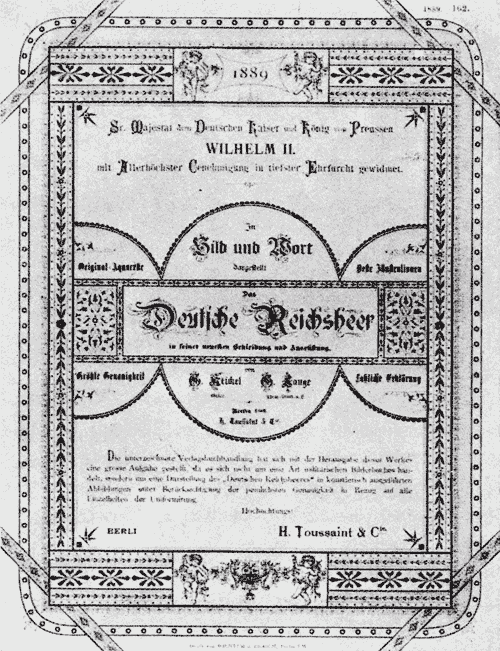
“The beauty was imposed and pushed upon the message,
rather than found within it”

It would appear that the designers of this time weren’t so confident in the messages their pages spoke.

In an effort to gain attention and add beauty, ornaments of flourishes, illustrations, borders and images were added in abundance as the beauty was imposed and pushed upon the message, rather than found within it.

White space was filled as it wasn’t seen as a design element. It was a quietness in the message, and the message can’t be quiet! It won’t be seen! It must scream and yell and steal attention.

Featured in The New Typography, Tschichold proclaims with a tone of absurdity:
“… not an invitation to a garden party but a funeral!”

And, oh, how the typography suffered! So many faces stacked high on each other, at random sizes and weights, balanced on a central axis and often crammed into whatever space was available. An element on the left must be weighed and mirrored on the right!

Rather than try to carve the statue of the message out of the stone, a lot of the designers were trying to make the stone.

All of this gave way to loud messages. They were becoming harder to hear as their designs began to scream louder and louder in an effort to gain the audience they demanded from all the other screaming messages.

Designer, Audience — Meet Clarity

Clarity is what was needed, and the Bauhaus and Futurist movements gave some designers a new idea of how it should be achieved.

These designers (Jan Tschichold was particularly the driving force behind such thought and literally wrote the book on The New Typography) didn’t just want a new way of expressing the message. They wanted to change culture and the way messages were perceived.

A brochure announcing The New Typography, strongly representing many of the principles Tschichold writes about. Note the strong contrasts, the hierarchy in font sizes and use of an asymmetric layout. (1928)

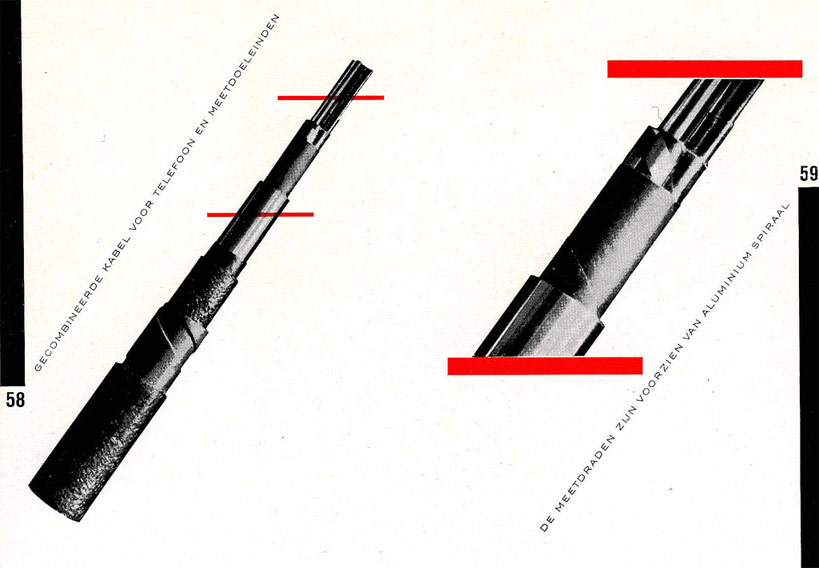
Spread from NKF cableworks catalogue designed by Piet Zwart.
The imagery and text dance with one another, rather than one simply pointing to the other. (1928)

“If the message could be understood easily,
it wouldn’t have to be spoken loudly”

What we might now see as ideas and thoughts on how to design a page, at the time the modernists saw strict rules that must be adhered to. The hope being to help man love his culturally different brother by tearing down walls of design and expression that divided.

If the message could be understood easily, it wouldn’t have to be spoken loudly. With so much striving to be seen, an empty page which merely stated “here I am, here is my message” would have been a visual haven.

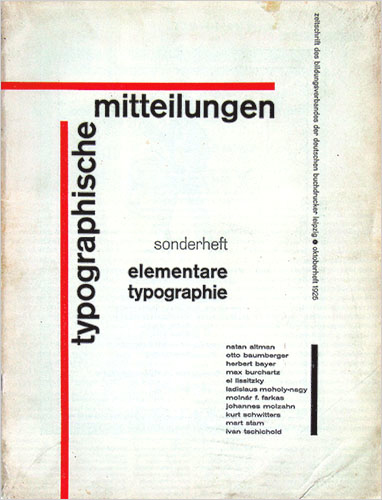
Cover of Elementare Typographie, a 24-page document designed and written by Jan Tschichold to explain his ideals relating to typography and design. (1925)

It was seen as necessary to push dramatic changes and not gentle suggestions. It was no small change they wished to see, so an overzealous mentality was essential.

Such strong feelings were generally seen as extreme many years later, even by those who screamed the loudest for them, but it makes it all the more interesting to look at things from their point of view for this introduction.

Why, It’s Design, Naturally!

A natural way to communicate was sought after. An organic design for the page, a natural form from the function, in which every element on the page was deliberate in its size and position. Every piece of text danced with the next, every image and line and shape worked in harmony to do one thing: communicate the message clearly.

“Each word must give way to the next.
Each block of text must guide the eye to the following”

Everything on the page is there to support the message and show its innate character. The way in which these elements are laid out are very important. Each word must give way to the next. Each block of text must guide the eye to the following.
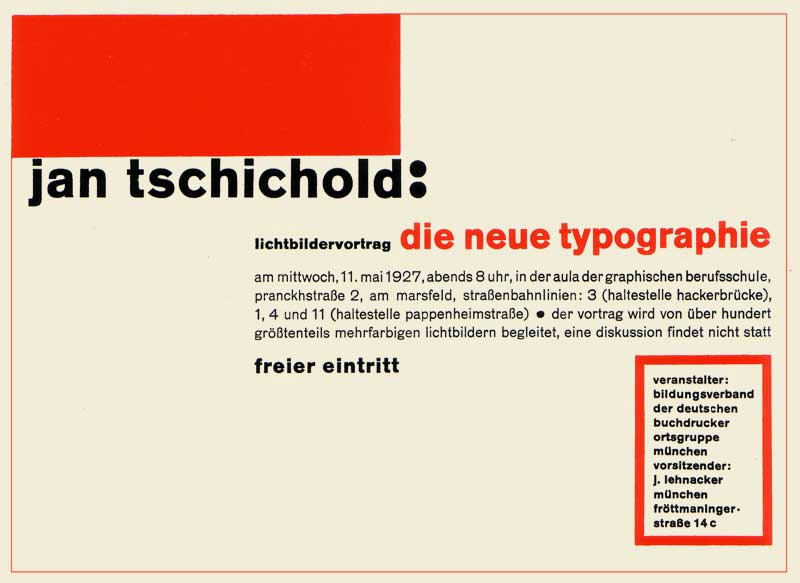
An invite to a lecture being held by Tschichold. “The lecture will be accompanied by over a hundred, mostly full-color slides; a discussion will not take place” reads the last sentence — clearly carrying an armful of conviction. Text swings so well from the red rule at the top that the eye is guided to the grounded box in the corner.

Another Tschichold example; showing how the image is wrapped
by the path of white space that’s set out for the eye to run.

Contrasts & Simplicity

This is best done through strong contrasts.

Contrasts in the size of type, in the weights and colour of it. The shapes it made and, especially, the white space it is guarded by. The very black to the very white.

A favorite of the modernist designer was combining black with red and the white of a page. If the heading is going to be bigger than the body, it must be far bigger because it is much more important — it draws us in. The colour shouldn’t be slightly different, but dramatically, so it can creates an intoxicating tension so we can’t help but nod to our voyeuristic lusts for the extreme.

Firing contrast on all cylinders (colour, type, size, shape).
The conversation on the right is calmed by the circle on the left. The shape of this one is a roller-coaster that pulls the eyes at a scream. “For the Voice” by El Lissitzky (1923).

Contrast in type sizes strongly establish hierarchy as the orange
works as a highlight which sings a siren song for the viewer’s vision. Herbert Bayer (1926).

A great way to achieve a beautiful contrast is by fully considering the white space of a page. The background can be brought to the front so that a block of text is asymmetrically balanced by the white space to its side. This was one of the biggest ideas that was played with and a major aspect of the early modernist’s doctrine.

Rather than fill the white space, it can be left empty so that what mattered would be seen and you wouldn’t be distracted by things around it—this empty space can guide the eye.

But above all, the strong contrast of font sizes, of colour and asymmetry of a page must have a reason that ties it to the message, how it’s being told and given its place with purpose. White space can’t be left empty for no reason, font sizes and margins and alignment can’t be defined without legitimacy.

Sometimes the message is just the message. It might not have an inner meaning that can be brought forward (think of a letterhead for a metal-works business or an advert for an accountant — often dry, huh?).

But this doesn’t mean that order can’t be given and brought forward. Sizes of type should be deliberate so that it is clear what is important and what’s to be read first, then second, third and so on. Whatever is on the page should be deliberately and thoughtfully put in its place.

This P-Block was designed by Piet Zwart as his personal logo, and when in use on this letterhead helps demonstrate the power contrast and balance a simple shape can bring to the page.

The eye is so strongly guided along the top, then swings around the circle but is caught by the small line of text which pulls you from the edge and sends you towards the names. Lovely! Such character and animation from a one colour cover! Hannes Meyer (1928).

Another fine example of contrast in font sizes to help establish hierarchy. The circle that hugs VORTAG is as strong as anything on the page, but with the space and reading direction around it, one can’t help but be drawn straight to it. Herbert Bayer (1926).

But contrast alone isn’t enough — simplicity is the key. The design should be simple so the contrast has a strong role on the stage, not just serve as the supporting act.

There should be fewer images so the ones shown draw attention, the colour palette should be deliberately limited, so what’s there has more power. Even the fonts should be simple.

Jan Tschichold, would later flip-flop and call bodies set in a sans as ‘genuine torture on the eyes.’ Serifs? Why would one use serif faces? They have these little kicks on them that are left from the time of chisels and crude materials. They are extra ornament and do nothing but clutter the page! Sans serifs are what needed, even for long bodies of text. Or so the thought went.

Give Me One Reason To Stay Here

It is said that Josef Muller-Brockmann engineered his pages rather than crafted them. Everything must be rationalised. Nothing can be done by eye as the page should be engineered and each element must find its place among the next. The size, leading, colour and length of every piece of text must be considered. Images have to speak with the text in a conversation fitted within the page.

“Type shouldn’t be bigger because you want it bigger,
but … because it deserves attention”

A rule and a circle and a square shouldn’t be added because something should be added, they should naturally find their places in an effort to bring balance and tracks for the eye to run along — they must belong so the message is strengthened. Type shouldn’t be bigger because you want it bigger, but because it needs to be bigger, because it deserves the attention.

To Seek Beauty in Form Itself

Remember what Paul Rand said — “Don’t try to be original; just try to be good.” It is the message above all else that matters. Never the whims of the designer who throws their selfish desires onto the page, snuffing the message and hoping desperately to make it look cool and awesome and clever.

This is what modernist design was all about three to four decades into the 20th century. Uncompromising—almost harsh—ways of communicating effectively.

This revolution of thought moved forward and would eventually be used wisely, and with less strict rules, as the Swiss (or the less romantic International Typographic Style) movement.

How could it not? Both were primarily concerned with clarity. But the difference is that while the early modernists would say “This is the only way to communicate” the Swiss inspired designers would say “This is one way to communicate, this is a starting point, let’s discover others.”

This early stage of modernism is fascinating to anyone who takes design seriously.

It can teach us so much about why people started to work this way. Why clean is better than messy — what pushed the mind-set of designers from one to the other. This is why I call this article an introduction — because there is a lot to look at, much more than mere thick rules, sans-serif faces and minimalism. There are ideas to be discussed.

It’s as important today to justify ones design decisions as it was in the 20s and 30s. It’s what makes our profession professional, it’s what makes the communication we speak easier to hear and it doesn’t let anything get between the message and the audience. It is what good design is all about — communication. It is this elegant simplicity which we mustn’t forget, as it’s what makes the work of the early modernists so beautiful.

REFERENCES & LINKS

Display
Display documents mid-20th century, modern graphic design history through a curated collection, feature articles and bookstore is the description you’ll find on thisisdisplay.org. I decided to use their words as mine couldn’t come close to describing the wonderfulness of this site. Forget Retinart, forget the Amazon links below, just go here and salivate.

Grain Edit
Grain Edit is one of those few graphic design blogs that does what it does perfectly. A constant source of inspiration and beautiful work of modernist graphic design and illustration.

Swiss Graphic Design: The Origins and Growth of an International Style, 1920-1965 at Amazon.com
A good look at the International Style that gave modernism in graphic design a marvelous upbringing

10 Brilliantly Fantastic Responses

    Richie

    Another great article and by Jove!! what an enlightenment! Design is so much more than what meets the eye.. I adore the modernists who set rules and sort-of laws so that beautiful and elegant designs were made instead of rugged and flexible ones.

    Its quite alluring to know that Typography was given such an intense and deep attention, including the contrast. I’m quite naive about the design in the post modern era, but this article has certainly inspired me to dig deeper.

    I believe there is certainly a huge deficit in the conventional style of design. Although, I cannot attribute my beliefs as I am not an art student. From what I’ve seen on may websites/posters, such attire is nowhere to be seen(or maybe it is hidden deep within the abyss). Either way, we need to adopt the modernist approach in solving design problems. This, in my belief is the most effective way in letting your design do the talking.

    This article has influenced me a lot to learn one of the most rudimentary laws of design : ‘Clarity’. From my opinion, most designs nowadays do focus on usability, simplicity and clarity. The idea is certainly right but the execution is not satisfactory! I may be wrong but thats how I feel when I lay my eyes on many websites (except yours, of course). There is a lot to learn as designer and an artist than just making beautiful posters. Modernists knew that and now we must embrace it.

    Once again, a very insightful article. Loved reading it. Did you notice that you are slowly metamorphosing into the ‘Socrates’ of Design? :)

    on a side note : is your blog powered by WordPress?

    Aaron

    on a side note : is your blog powered by WordPress?

    Not my site, but yes, it is.

    Excellent article, as a Literature major with a specialty on the Modernist Poets, it’s interesting to see how the principles of Modernism affected different aspects of art ranging from poetry to typography.

    Derrick Schultz

    This is a bit of odd revision of history—I think it’s fair to say that most designers now use modernism’s aesthetics to express clarity…though most minimalism does in fact not equal clarity. It certainly wasn’t their intention in the 20s and 30s

    To these specific points: 20s and 30s modernism as done by the Bauahaus, de stijl, futurists or whomever was less about clarity and more about the idea of creating modern design for modern times—i.e. that as the industrial era progressed, we needed work that visualized that existence. Ornamentation and craft work—what design was before modernism—was a labor-intensive process done by a skilled craftsman. What most of the early modernists were looking toward was a design using machines and following machine-like precision (Moholy-Nagy famously “phoned in” one painting to its maker to show design could be done by anyone following machine-like instructions). Machines knew not how to create ornamentation, nor was there room for the time intense process as such in the industrial age. The early modernists were still artists in most ways—the futurists were making visual poetry, about as unclear as you can imagine text on a page to be (certainly not digestible like information design is meant to be now). That some of their work (mostly their commercial work) appears clear is likely due to its commercial nature, not their immediate desire for things to be more clear on the whole.

    It’s always difficult to use Tschichold as an example unfortunately, as he turned his back on Modernism post-World War II, calling it fascist and fearing its machine-like qualities actually repressed humanity (a prefect example of how early modernism was almost against human clarity in some interpretations). He kept the centuries-old rationality of proportions and grids, but returned to serifs and ornaments (notably more subtle, but still there)

    50s and 60s modernists, notably the Swiss, were hugely inspired by the visual aesthetic of this early group, but their psychological motivations were based on the notions of universality and universal symbols (though that often resulted in abstract graphics that weren’t all that clear)—but the motivations between the two groups were really quite different. Machines were the norm by then, so they had less to say in that department. But as corporations turned global, they saw the need for visuals that worked across languages (hence the standardized grids that could hold any language, and abstract graphics that would eschew individual culture’s of their historic symbols).

    Suffice to say, now we use modernism for yet another purpose—still tied to technology though, I might mention—but it’s become something different again.

    Alexander Ross Charchar

    Haha, thanks Richie! Glad you liked the article :)

    There is an insane amount of theory and consideration given to typography that I think it’s where a good majority of ones design education should be concerned. It’s different with the web in a lot of ways, which might be why I like print so much, but the theory is very, very mature and evolved — well worth diving into it!

    Modernism survived and much of its principles are just standard for many designers working today.. ie. much of what Pentagram produces is beautifully modernist. Though I do think a lot of new designers (as would happen in any profession) are happy to tout and scream ideals when they don’t fully understand them. So while many would call for clean, elegant design, few will execute it properly.

    What do you think?

    And as Aaron was kind enough to answer, yes, Retinart runs on WordPress (and about a million plugins and a custom theme).

    Hi Derrick,

    Firstly, I have to say thank you for such an enlightening comment. While the following might be lengthy, I hope it doesn’t come along with an argumentative tone, but one of discussion and educational intrigue :)

    Using Tschichold’s writing as a source could be risky, I totally agree with the reasons you gave, but I can’t help but feel that sourcing material he wrote in 1928, when he felt so strongly about modernism (/The New Typography), helps give some context and a feel for the mood felt at the time.

    I think it’d be riskier referencing his later materials when, as you said, he had turned on it so sharply (and probably riskier still to go even later when he just quietened down and suggested that his response of calling it Fascist was extreme — I must admit I love his passion), which is why I tried to avoid it.

    But considering his influence of this time and movement, how can I not reference his seminal text on the topic?

    Tschichold wrote that “technology … can never be an end in itself, only a means to an end”, which to me would suggest that while the early modernists were interested in using technology to develop their messages, it wasn’t all they were concerned with. So while the machine precision that you mentioned might have been pivotal, I don’t think it was precision for the sake of it. I think if it was only the act of precision they were concerned with, then they would have attempted to precisely replicate ornament (in the same way Gutenberg wanted to replicate the scribes) but with repeatable precision.

    So with the design wanting to reflect the changing times, then (as design is communication) the cleaner, neater, design was a reflection of the way people were communicating — or needed to be communicated to. Again, to quote Tschichold “as a rule we no longer read quietly line by line, but glance quickly over the whole, and only if our interest is awakened do we study it in detail”.

    So to me it would seem as if, even if not at the forefront, clarity was a key foundation upon which modernism was built.

    All that being said, I do agree with you that the clarity that came from their work was probably more a case born from “its commercial nature, not their immediate desire for things to be more clear on the whole”.

    But (sorry to be so blunt) so what? Isn’t it still the time when design turned from ornamentation to something cleaner? Whether the clarity was major or minor in concern or execution, it’s still when the shift occurred.

    So while the birth of modernism and strong clarity might not have been a perfect marriage, I do think that at the very least, one was the child of the other.

    Perhaps I should have titled the article “Clarity” coughed the modernist?

    I think where this article might trip up a little is that I used later modernist materials/thoughts (that had a couple decades to evolve) to express a moment in history that was a little more in and of itself (the 30s).

    Thank you again for such a fantastic comment and discussion.

    inspirationBit

    kudos to the article and the discussions in the comments.

    I wonder how one would call the design direction in the XXI century? It seems that it’s changing every year… but more often than not, it’s rather a copycat movement that rules nowadays. We copy what we dig out from the design history or as soon as someone comes up with something that stands out we copy them…

    Justin Farmer

    So well put sir, I’m very happy to have discovered you and your inspiring thinking today. Keep it up.

    Alexander Ross Charchar

    Inpsirationbit
    I’ve been trying to figure that out too.. and in a big way I think you’re right, much of what we see is just copied ideas and layouts. But thats the problem when you’re looking at a moment that you’re part of — we might only notice what’s in abundence, not what stands out. I’d like to think that given a few decades, we might look at this time as being one in which User Experience was better considered and designers strove to make their audience happy, rather than just a functional website.

    And on the print side of things, maybe what will come out is this new interest in letterpress that’s being going around for the last few years — rather than just being about printing, it’s about having an interaction with the paper and, again, wanting to create a little joy and excitement in those who handle it …

    So maybe it’ll all be about happiness!

    Thanks Justin, I’m glad you liked the article enough to leave such a nice comment :)

    Derrick Schultz

    Whew, sorry for the delay in response…

    I’ll begin with saying just about everything ends up being interpretation—even amongst those people who began the movement. I think Tschichold, as mentioned, is a difficult example. He not only reversed his own beliefs, but I’m sure using just him to speak on behalf of the Bauhaus/any Avant Garde movement is a difficult one (the Bauhaus throughout its history was a fractured group of individuals…some shared common beliefs, but many seemed to have simply bounced ideas off of each and often fought over them). Tschichold had his ideas, as did Moholy-Nagy, as did Klee. None of them follow a single trajectory, and I’d argue almost none of them saw clarity as their main intention—at least not what we might call “clarity” by information design standards.

    It’s dangerous to take people at their word and just leave it at that. Even those of us who aren’t politicans still have blind spots and biases. Tschichold may say that the technology is never the ends to a means, but I’d be hard pressed to imagine an instance when his exacting works would make sense made by hand for millions of impressions. It just doesn’t add up. It’s a chicken or the egg phenomenon, but to denounce either the chicken or the egg as insignificant seems misguided.

    Whether or not you choose to buy into the interpretation, many design historians have interpreted the 20th century Western design movement as a cause/effect of rapid industrialization. Here again we come to a chicken/egg conundrum. Did the technology/industrial movement occur first or the desire for a more clear, efficient design? More than likely they fed each other. Clarity, or some sense of it, certainly sells products well—and efficiencies ensure they are cheap enough to profit from.

    Design never operates in a vacuum, but its art roots tried pretty hard (If you haven’t read Tom Wolfe’s “From Bauhaus to Our House” I highly suggest it for both a laugh and a fascinating interpretation of the era). Like the cool art kids you probably knew at some point in your life, being obtuse is cool, and the early Avant Garde’s were the proginators. Take Johannes Itten, the father of modern color theory at the Bauhaus. He was a pretty weird guy (and the Bauhaus theater department—really weird!), but parts of his color theory seemed palatable as the next generation developed. Albers took his ideas and made them more acceptable for the modern generation (ahem, a more industrialized world, wink wink), and the next generation took color theory into information design and absolute design uses. If you look back at Itten’s books now, you can see the trajectory and visualize it through our modern theories of design and it makes total sense, but it’s lost the mysticism he believed in with it. Each generation distorts the views that came before it—it’s ‘s natural, not unlike the winner of a war getting to write the war’s history. But that doesn’t mean the rewrites are very accurate.

    So you ask:
    “But (sorry to be so blunt) so what? Isn’t it still the time when design turned from ornamentation to something cleaner? Whether the clarity was major or minor in concern or execution, it’s still when the shift occurred.”

    My point is that if you’re looking for the shift from today’s point of view, it matters very little—it’s doubtful this generation of design will go back to the Expressionism and mysticism of Itten. Call it Design Darwinism if you will…the ideas that made it to this point are the winners and probably matter most to us. But those ideas, along with the others that lost, made up the historical landscape. Clarity probably matters more to us now—but amongst the amoebas of its time it was just one type in the swamp.

    Alexander Ross Charchar

    Fantastic. Absolutely fantastic, thank you.

    I’ll start by saying that I am only beginning to enter history. And something you said made me realise just how early in that journey I am.

    Context is becoming a bigger and bigger concern for me the more I read about history and try to establish connections and understand the moments I’m exposed to. In this instance, my journey to modernism was taken via the route that Tschichold provided – his opinions, his writings and so on. It was all I knew. He says something about ornament, all the modernists said it. He berates serif faces, they all do.

    Of course, the more I learn the more I realise that is a naïve path to take, but without walking down it (by writing the article, having it discussed and challenged here), I’ve got no way of knowing that. But as you said, each person has their own views, and just because they might be well known views, it doesn’t mean that they’re necessarily well shared views. Oddly enough, when it comes to fiction, I always question any novel that is told in first person – what they say is what they choose to say. It’s first lesson Literature from high school. But for some reason, when reading non-fiction (in this case, The New Typography, for example) I did the utter opposite in a way, didn’t I? I didn’t think to question what Tschichold wrote, and in fact attributed his opinions to an entire movement in a (not all, but) number of occasions.

    It’s a peril of my self-education, especially one as broad as art and design history. The best solution is obviously to learn absolutely everything I can so the context is there and conclusions better reasoned. The only issue with this is that it’ll take me many, many years to do that – I haven’t got a structured curriculum to follow that makes the journey easier. I’m kind of just jumping in wherever I can and trying to establish my footing.

    That being said – I’m going to continue writing as best I can – even if my scope is horribly narrow for the time being. Why not? It’s a journey I hope others take with me as they read what I write – I’ll just be more cautious of not over generalising and simplifying. More commentary is what I need, more than anything else, I think. This is where opinion plays a big role in history, isn’t it? Just reading about the moments can help give knowledge of them, but an understanding of them is much harder to come by.

    Luckily, I don’t mind being the naïve student :)

    Thank you

    Fernando Mix

    I am really thankful to this topic because it really gives up to date information “*’

I would be so delighted if you were to contribute